
In brief: Fairing makes a yacht's surface true before the topcoat goes on, so that reflections run straight along the hull without ripples or hollows. Fairing compound fills the deviations left by construction or damage, then long boards sand it back to the designer's lines. Our team has faired superyachts, sailing yachts and racing yachts since 1990, ahead of Awlgrip, Alexseal and Hempel topcoats.
A superyacht topcoat only reflects as well as the surface beneath it. Fairing is the process of making that surface true, so that reflections run straight along the hull without ripples or hollows. Our team has been fairing superyachts, sailing yachts and racing yachts since 1990.
What fairing is
Steel and aluminium hulls are never perfectly fair after construction: welding distorts plates, and frames show through. Composite hulls have their own variations. Fairing fills and shapes these deviations with fairing compound, then sands it back with long boards until the surface follows the designer's lines.
Our fairing process, step by step
- Survey the hull: long battens and raking light map the highs and lows, and we check any existing fairing for cracking, poor adhesion or moisture.
- Prepare the substrate: we blast or grind to sound metal or laminate where needed, then apply the specified primer straight away to protect it.
- Screed the first coats: fairing compound is applied with long screeds to the manufacturer's maximum layer thickness, and each layer is allowed to cure.
- Longboard: crews longboard by hand along the run of the hull, so reflections will follow the designer's lines.
- Check and correct: battens, guide coats and light are used again and again to find the last lows, which are filled and boarded.
- Apply high-build primer: high-build primer seals the compound and is sanded to remove the final small defects.
- Record and sign off: temperature, humidity, dew point and cure are logged throughout, and the surface is inspected before the undercoat and topcoat programme starts.
Before and after
These photos from our own repair records show a section of GRP bow before and after the fairing stage: ground back to sound laminate, then rebuilt, faired and sanded ready for the paint system.
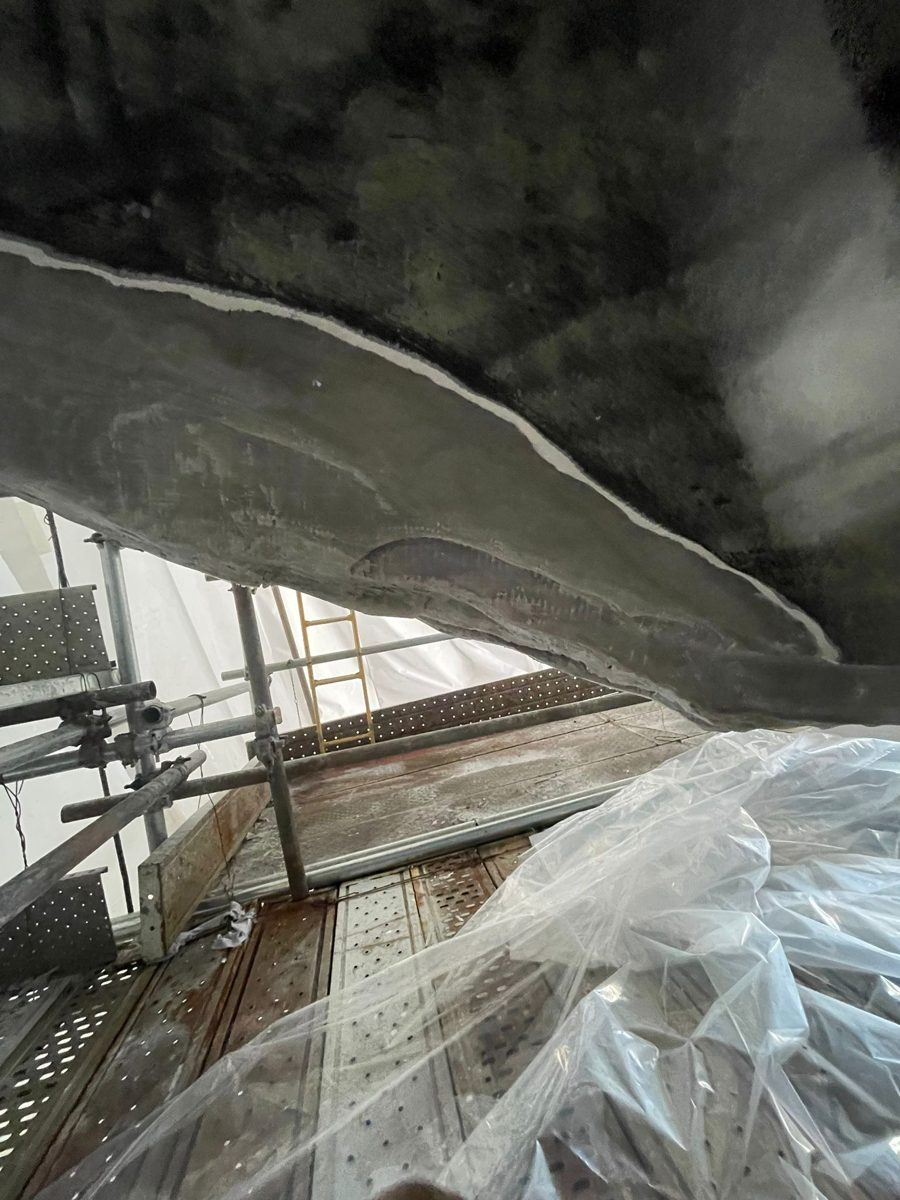
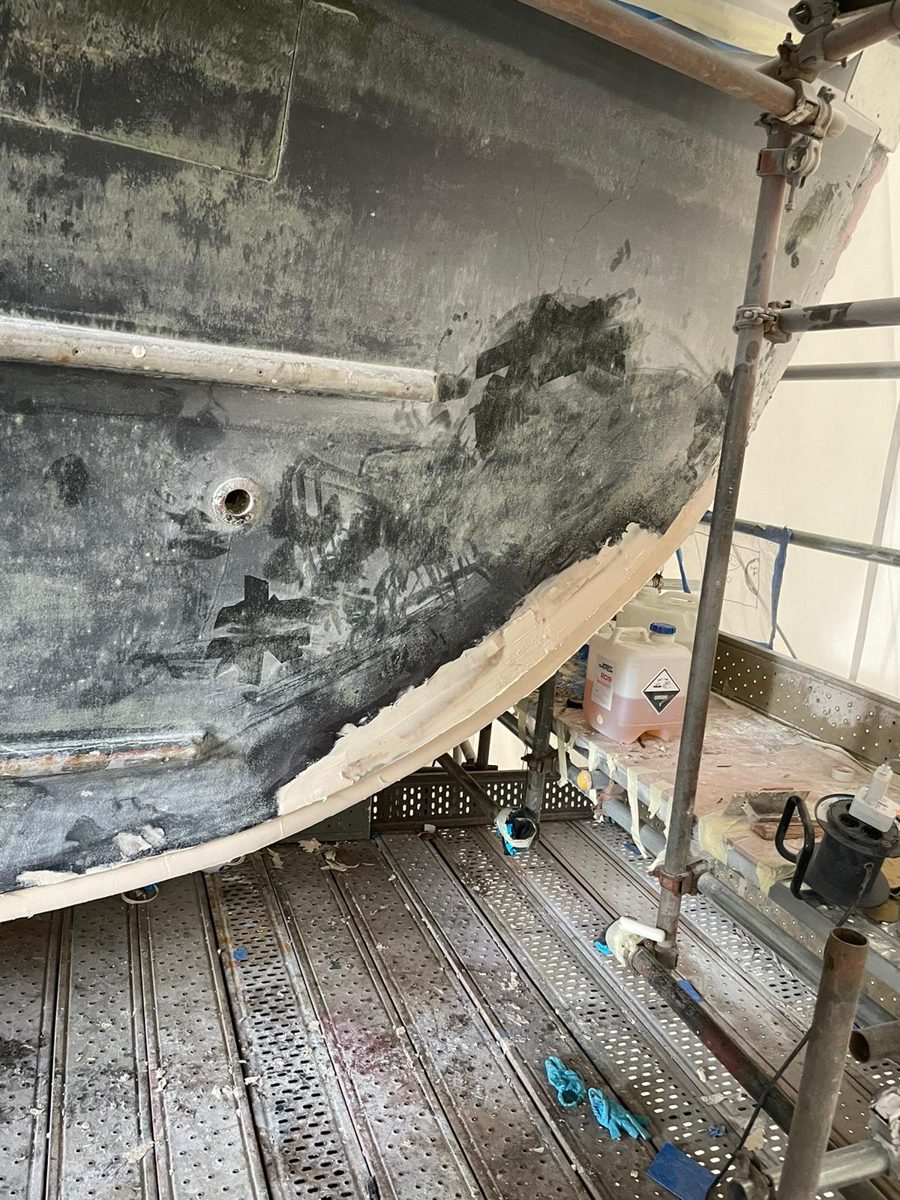

Read the M/Y Sea Pearl refair and repaint case study.
Full fairing or fairing repairs?
A full fairing is part of most new builds and some full repaints, where old coatings are removed to bare metal. Fairing repairs restore damaged or cracked areas and blend them into the existing surface. Many of our refit projects combine both, for example the fairing repairs and full Awlgrip repaints on M/Y Leander G (75 m) and M/Y Indian Empress (95 m). See full repaints.
Racing-specification fairing
Fairing a racing yacht adds a second requirement: weight. On Vestas Sailrocket 2 every product applied and every gram sanded off was weighed, so the boat stayed as light and streamlined as possible. She went on to set the outright world sailing speed record over 500 m in November 2012. Read the Sailrocket case study.
Fairing in hot and humid climates
Fairing compounds have strict temperature and humidity limits for application and cure. In Asia we work under cover with environmental control, and record conditions throughout. We run newbuild fairing the same way at 189 Shipyard, Haiphong. Superyacht new-build painting.
Fairing and the paint system
Fairing compounds must be compatible with the primer and topcoat system that follows. We work with Awlgrip, Alexseal, International, Jotun and Hempel systems, and follow the manufacturer's specification from substrate to topcoat. Awlgrip vs Alexseal.
Yacht fairing on motor, sailing and racing yachts
The method is the same on every yacht: a true surface, built up in cured layers and checked with battens and light. What changes is the substrate and the priority. On steel and aluminium motor yachts, most of the work is taking out weld distortion and frame lines across large topside areas. On composite sailing yachts, it is about stopping core and laminate print-through while keeping weight down. On racing yachts, weight comes first, so every product is weighed, as it was on Vestas Sailrocket 2.
Common fairing defects and how we prevent them
- Print-through. Frames, welds or laminate showing in the finish. We prevent it with enough build and a full cure before final boarding, and we check under raking light before priming.
- Shrinkage and sink-back. Compound that is not fully cured keeps shrinking after the topcoat goes on, and the hollows show months later. Fillers and primers are checked with Shore D hardness tests before the next layer. See why cure times matter.
- Pinholes and air voids. Trapped air in the compound opens up under primer. Screeding technique and a pinhole fill before high-build primer keep it out.
- Cracking and poor adhesion. These usually trace back to surface preparation, primer overcoat windows or layers above the manufacturer's maximum thickness, so all three are controlled and recorded.
- Sanding through. Guide coats show where material is coming off, so the team stops before cutting through to the layer below.
- Contamination between coats. Epoxy surfaces are cleaned and prepared as the manufacturer's data sheet requires before the next product goes on.
What decides the length of a fairing programme
We do not quote a standard duration, because each yacht is different. The programme is set after the survey by:
- the area to be faired and how far the surface is out of true;
- the substrate, and whether old fairing has to come off first;
- how many fill-and-board cycles are needed to reach the agreed standard;
- cure times at the temperature and humidity on site;
- covered space, access and environmental control at the yard;
- the inspection hold points agreed in the specification.
What you receive
- A written scope after the survey, stating full fairing or fairing repairs.
- A log of temperature, humidity and dew point for the whole programme.
- The products and batch details used for each layer.
- Progress photos during the job, shared in the YRA Project Status App.
- Sign-off at each hold point before primer and topcoat, against the criteria on our paint inspection page.
Our in-house team carries out fairing in Singapore, Thailand and Vietnam, and fairing is the base of every superyacht full repaint. It is also the first stage of our superyacht painting and yacht hull painting work.
Frequently asked questions
Why does fairing take so long?
Each layer must cure before it is sanded, and the surface is checked and corrected many times. Good fairing cannot be rushed. See why cure times matter.
Does a repaint always need full fairing?
No. If the existing fairing is sound, preparation and local repairs may be enough. A survey or paint inspection tells you which.
Can you repair cracked fairing?
Yes. We remove the failed area, find the cause and re-fair it to blend with the surrounding surface.
Do you fair composite and carbon yachts?
Yes, including racing yachts. See composite repairs for superyachts.
Do you fair new builds for shipyards?
Yes, as a subcontractor. See superyacht new-build painting.
How is fairness checked?
With long battens, raking light and guide coats at every stage, and against the acceptance criteria agreed in the specification.
What is the difference between fairing and filling?
Filling repairs a local dent or chip. Fairing shapes a whole area to a true line, so reflections run straight across it.
Which fairing compound do you use?
The compound specified within the chosen paint system, such as Awlfair within an Awlgrip build-up, so compound, primer and topcoat are compatible.
How can I tell if my yacht's fairing has failed?
Look for cracks along frames or seams, blisters under the paint, wavy reflections where areas have sunk, or paint lifting. A paint inspection confirms the cause.
Talk to us about fairing
Contact Superyacht Painters · info@superyachtpainters.co.uk · +66 (0)80 829 0122
Superyacht Painters Ltd, The Clock House, Western Court, Bishop's Sutton, Alresford, England SO24 0AA
Superyacht Painters Ltd, registered in England and Wales, company no. 12103117