
How we paint a yacht hull
A dark, high-gloss hull shows every flaw underneath it, so hull painting is decided by preparation and fairing long before the topcoat goes on.
- Survey and preparation: assess the existing system, then sand back or remove it as the specification requires.
- Fairing: full or partial fairing to restore true lines. See superyacht fairing.
- Hull systems: epoxy primers, build coats and high-gloss topcoats to leading superyacht paint manufacturers' specifications, with colours specified against official colour cards.
- Climate-controlled tenting: in tropical humidity we apply full systems in climate-controlled tenting or covered paint sheds, and record temperature and humidity in our paint application reports.
- Boot tops and underwater systems: boot stripes, cove lines and antifouling and underwater hull systems.
Our process standard: blast, fair, finish, repaint
There is a saying in our trade: “99% surface preparation, 1% applying the finish coats.” It is a saying rather than a measurement, but it is why our process standard is written to leading superyacht paint manufacturers' specifications, with independent ISO standards named wherever they apply.
1. Blast: cleanliness, profile and abrasive
- Steel: grit blast to white metal, SSPC-SP10 / Sa 2½ (ISO 8501-1), with a 50–75 µm surface profile (profile assessed to ISO 8503). Alternatively grind with a 36 grit disc to bright, clean steel with the same 50–75 µm profile.
- Aluminium: low-pressure grit blast with aluminium oxide or an equivalent abrasive, never copper slag, or grind with a 36–60 grit disc, to bright silver metal completely free of grey oxidation, with a 50–75 µm profile. Jagged blast profiles are ground to remove spikes.
- Before blasting: weld spatter removed and edges rounded to a minimum 2 mm radius. Soluble salt testing (ISO 8502) is considered, especially if the hull has been afloat uncoated.
- Time to prime: blasted or ground metal is primed in the same work shift, within 8 hours. If 8 hours is exceeded, the surface is sweep blasted or given a clean-up grind first.
- Hydroblasting is not accepted as final preparation under filled and faired systems; the surface is abrasive sweep blasted before priming.
2. Re-fair: fairing compound and high-build primer
- Bare metal is sealed with an approved epoxy substrate primer before any filler goes on.
- Epoxy fairing compound is trowelled on in areas that can be worked in 15–20 minutes, starting with coats up to 6 mm in the low areas and building out to the high areas. A maximum of 5–6 mm per application is used to minimise air entrapment, with air pockets kept below 4 mm.
- Each application is block or machine sanded with 36–80 grit before the next. Where battens are used, batten lines are ground out to a taper of more than 7:1 before refilling.
- Fairing stops when the surface meets the fairing quality specified for the project. Manufacturers do not publish a universal fairness tolerance, so the tolerance is agreed in each project specification.
- Filler is then sealed with full coats of a high-build surfacing primer before undercoats.
3. Finish: build-up, film thickness and inspection
- Epoxy primer / undercoat: applied in 3 coats at 35 µm dry film thickness per coat (45 µm maximum), with at least 50–75 µm remaining after sanding.
- Before topcoat: primer smooth sanded with 280–400 grit, using a contrasting guide coat, for maximum gloss and distinction of image (DOI).
- High-gloss polyurethane topcoat: 3 spray coats at 25 µm dry film thickness per coat (75 µm wet).
- Conditions: no application to surfaces less than 3°C above dew point; ambient temperature between 13°C and 41°C. In tropical humidity we work in climate-controlled tenting or covered paint sheds and record temperature and humidity in our paint application reports.
- Inspection: dry film thickness measured to ISO 2808; gloss measured to ISO 2813 and adhesion checked by cross-cut test to ISO 2409 where specified. Appearance and DOI acceptance levels are agreed in the project specification, since no single figure is published for every system.
4. Repaint: full repaint or overcoat?
- Survey first: the existing scheme is inspected and three checks carried out: cross-hatch adhesion, solvent resistance and coating compatibility.
- Overcoat, good or fair condition: sand P320–400 and remove all gloss, then prime and topcoat.
- Overcoat, poor condition: sand P120–180 and remove all gloss.
- Fairing required, good or fair condition: hard machine sand P80, removing all damaged or cracked layers back to sound primer or filler.
- Full repaint, poor condition with fairing: sand P60–80 or abrasive sweep blast back to sound epoxy primer or filler, removing all existing topcoat, with spot blasting to bare substrate where needed. Any bare metal exposed is primed before other primers or fillers.
- Refresh without repainting: on buffable topcoats, down-glossing and light scratching can be corrected by buffing, polishing and sealing, provided the remaining topcoat film stays above the manufacturer's minimum thickness. Non-buffable topcoats are cleaned only.
Hull painting in Singapore
Our head office is in Singapore. Our current project there is a 76m superyacht at ST Engineering Marine: full fairing and a new hull paint system in a controlled painting environment. For boat painting in Singapore, from paint repairs to full hull repaints, see superyacht painting Singapore.
Hull painting in Thailand, Vietnam and across Asia
Our Thailand branch is at Ocean Marina Jomtien near Pattaya, with work in Bangkok, and we carry out new build painting in Haiphong, Vietnam. See yacht painting in Thailand and Phuket and superyacht painting Vietnam. Our team also travels to Hong Kong and Japan.
Hull painting projects
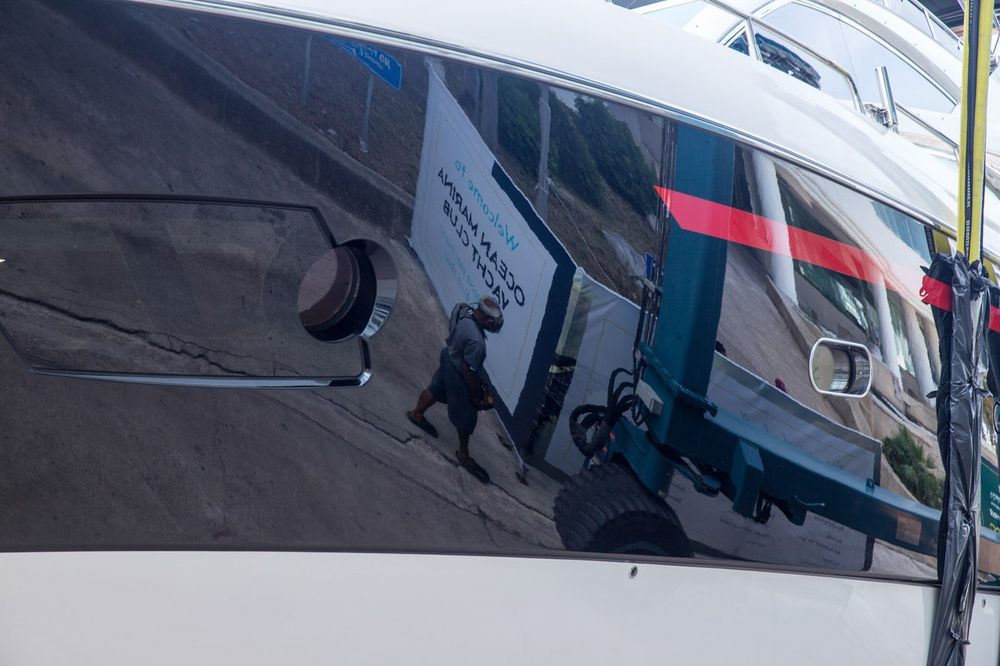
- Sunseeker Manhattan 73, Thailand: full hull repaint in jet black with a red style line, epoxy primer and a buffable, repairable topcoat, Ocean Marina, December 2021.Delivered
- 76m superyacht, Singapore: full fairing and a new hull paint system at ST Engineering Marine.In progress
- M/Y Sea Pearl, 60 m, Bangkok: full Alexseal refair and repaint. Case study.Delivered
- S/Y Mirabella V, UK: hull, topsides and deckhouse topcoats, a new Hempel underwater system and ceramic fairing of the keel fin, VT Shipbuilding.Delivered
- M/Y Leander G, 75 m, UK: fairing repairs and full repaint.Delivered

Every programme is documented in the YRA Project Status App, with twice-daily work photos and paint application reports recording temperature, humidity and hardness tests. For our wider service, see yacht painters and yacht painting and superyacht full repaints.
Yacht hull painting: frequently asked questions
Where do you carry out yacht hull painting?
From our bases in Singapore, Thailand and Vietnam, and on site in Hong Kong, Japan, the UK and worldwide. In Singapore our current project is a 76m superyacht at ST Engineering Marine.
Do you do boat painting in Singapore?
Yes. Our Singapore head office handles hull painting, repaints and paint repairs for yachts and boats, with full fairing and a new hull paint system on our current 76m superyacht project.
Which hull paint systems do you use?
Two-pack epoxy primers and high-gloss polyurethane topcoats from leading superyacht paint manufacturers, with underwater systems where specified.
How do you deal with tropical humidity?
We apply full systems in climate-controlled tenting or covered paint sheds, and record temperature and humidity in our paint application reports.
Do you paint underwater hulls and antifouling?
Yes. We apply underwater hull and antifouling systems; see our antifouling and underwater hull page.